The world layer
A planet you can reason about.
Kano grows whole worlds from a single seed — geology, climate, hydrology, weather, life — every place coherent enough to explain why it’s there. Not a heightmap. A world that means something.
Alpha release · try it now
Download the alpha release of Hīkoi and walk our demo world — one zip, runs offline, MCP server included, so your own AI can query the same ground you’re standing on.
The world builder
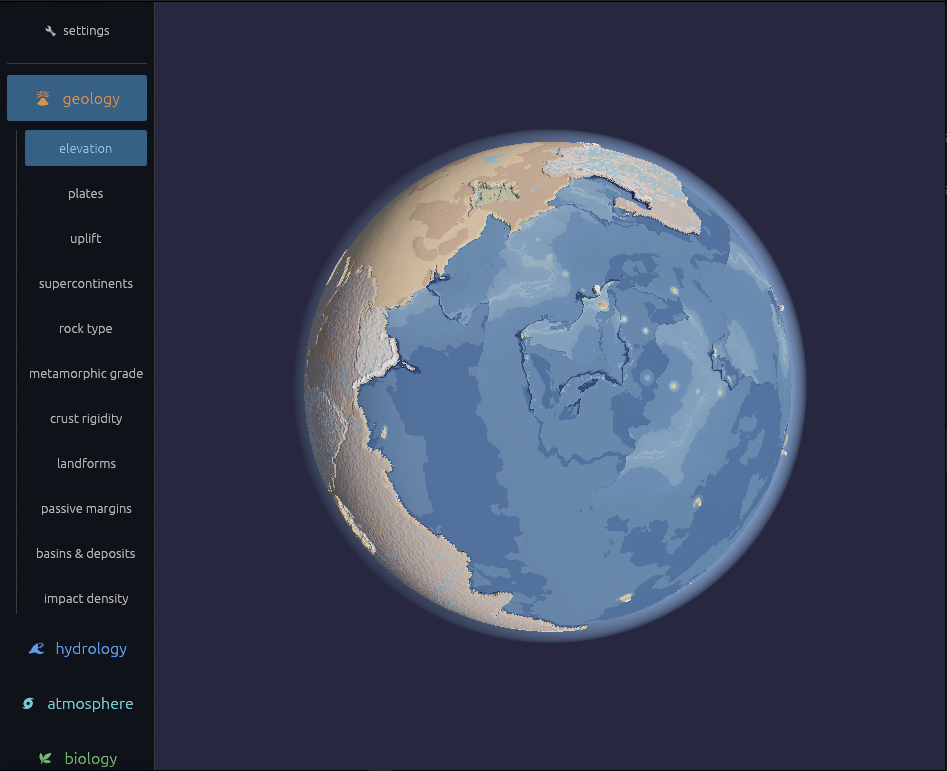
Kano — te reo Māori for seed — is where a world begins. Press a key and a whole planet falls out of a seed: continents from plate tectonics, mountains from collisions, deserts from the rain shadows those mountains cast, rivers that actually run downhill to the sea. Nothing is hand-painted — not the rock, not the gems, not the plants, not a single texture. There are no baked assets; each layer is conditioned on the ones beneath it — tectonics shapes terrain, terrain shapes water and climate, and those decide what can grow.
You build at the globe scale and read the planet through four stacked layers, each its own view of the same world:
Geology
Plates, lithology, stratigraphic columns — the bedrock under everything.
Hydrology
Drainage, river networks, lakes and deltas — the flow of water across the whole sphere.
Atmosphere
Pressure, temperature, rainfall and wind — the synoptic weather that gives each region its climate.
Biology
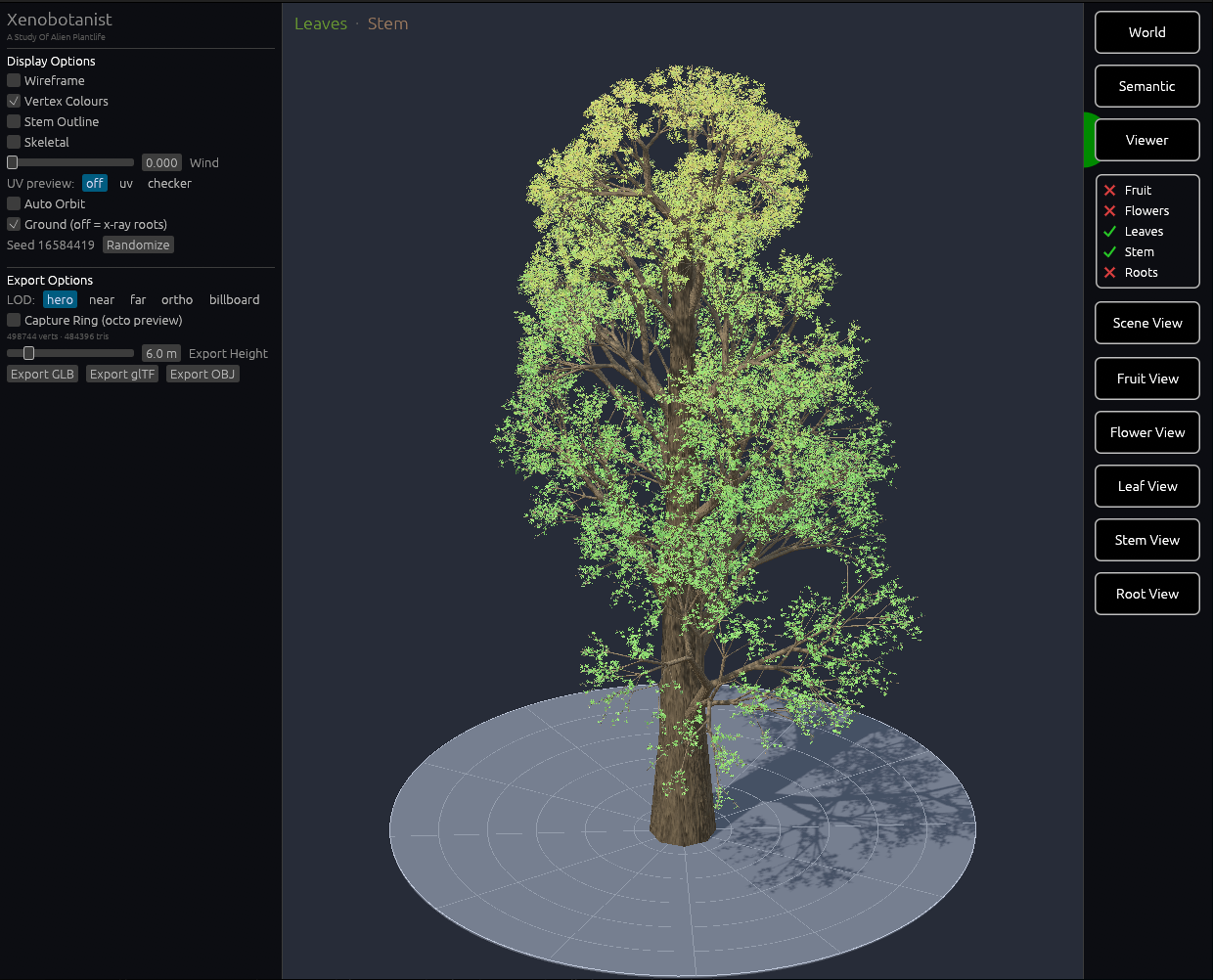
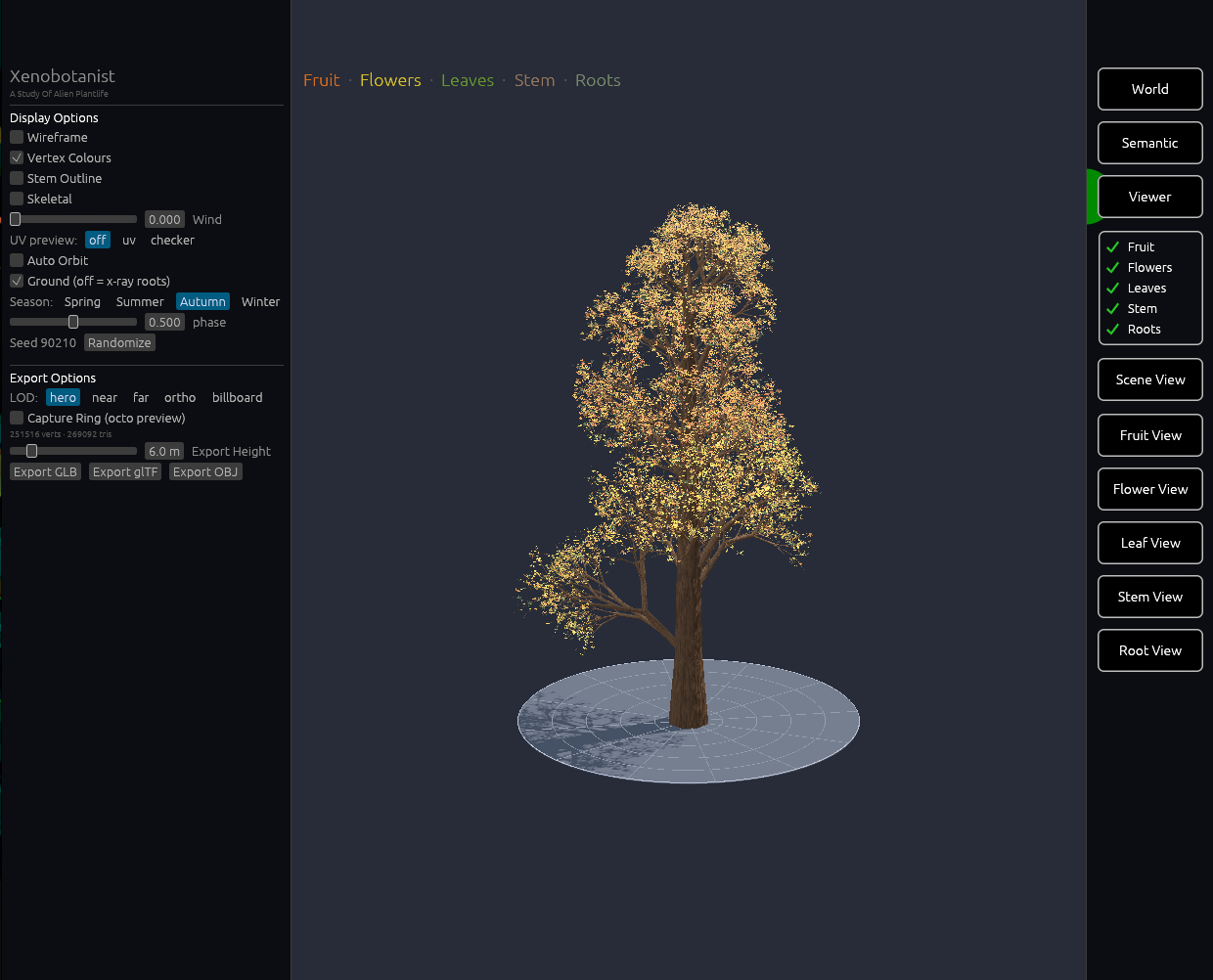
Whole living stands grown from the ground up: vegetation that answers to the local soil, moisture, slope and shade, its foliage even tinted by the world’s own star. Not a texture of green — a plant census with a life history.
Turn a dial — obliquity, insolation, day length, sea level — and the world answers honestly. Flatten the tilt and the seasons die. Slow the spin and the weather collapses toward a single great cell. Kano isn’t decorating a globe; it’s running the causes.
The one idea underneath it
Determinism
Every world is a pure function of position, time, and seed — F(x, t, seed). There is no saved simulation, no unseeded randomness, no hidden mutable state. On a given engine version, the same place at the same moment reads identically, and you can run the clock backward as easily as forward.
That sounds like an engineering footnote. It’s the whole point:
A seed is the world. Share a short address and, on the same engine version, someone else opens the same planet from the seed alone. The bookmark is the database.
It’s rewindable. “Was this valley wet three months ago?” is a question with one true answer, because time is just a parameter.
It reconstructs, not downloads. A modest device can rebuild the neighbourhood it’s standing in from the seed instead of downloading it.
Down to the individual. The same tree stands in the same spot on every visit — a place keeps its exact flora across sessions on the same build, not just its terrain.
Where it fits: the Taniwha stack
Kano is the bottom of our AI stack — the ground our agents stand on.
Most AI lives in a vacuum: a model with no place, no consequences, no shared ground truth. We turned that around. First build a world that is real enough to reason about — coherent, deterministic, queryable — then put minds in it. Kano is that world layer. Everything above it reasons over a planet that can’t lie to it and can’t contradict itself between two machines.
Agents — the minds. They observe the world, remember it, predict it, act in it.
Interface & memory — how an agent turns a world into knowledge it can reason and recall over.
Kano — the world — deterministic procedural planets. The ground truth everything else observes.
The world gives honest observations; agents own belief and prediction.
Kano will tell you exactly what the sky looks like right now from where you’re standing — it will never hand an agent a forecast oracle. Foresight has to be earned from experience, the way it is for anything that actually lives somewhere. That’s what makes a Kano world a real place to be an agent, and not just a backdrop.
The toolkit
One seed grows the world. A small family of tools lets you shape it, walk it, grow things in it, and let an AI ask it questions.
World Builder
F(x,t,seed)Where a world begins
Working prototypeGenerate and shape a planet at the globe scale; read it through the Geology, Hydrology, Atmosphere and Biology layers.
Hīkoi
first-personStand on the ground
Alpha release · on GitHubHīkoi — te reo Māori for walk. Drop from orbit to any point on the planet and walk it — terrain, weather, light, and vegetation grown live around you: grass swards, trees at eye level, foliage in the colour the world’s star paints it. In the browser or native.
Botanist
.flora DSLGrow the living layer
Working prototypeA studio for the plant life that covers a world. Explore what a Kano world grows — single specimens or whole interleaved stands — design your own species in a compact plant-description language, and export them to Unity, Godot, Blender and friends.
Kano MCP
30+ query verbsLet an AI ask the world
Alpha · ships with the showcaseA world becomes a database an AI can interview directly. Over the Model Context Protocol, a model can ask any place what it’s made of, what grows there, what the weather’s doing, why the desert is where it is — and even whether two distant valleys grow the same kind of forest. Every answer traces back to the world, never to a guess.
Three things you won’t find stacked together anywhere else
It’s causal, not cosmetic.
On Earth, “why is this desert here?” takes an expert to infer. In a Kano world the cause is recorded: this plate boundary → this mountain range → this rain shadow → this desert. The chain runs all the way to the colour of a leaf — on an alien world, the plants are the hue their star makes them. The world can explain itself, correctly, all the way down.
It’s the same world for everyone on the same build.
Determinism means a seed is a contract. On the same engine version, your world reproduces the same for you and for a collaborator on the other side of the planet — from the seed alone, with no assets to ship.
It’s built to be inhabited by minds.
Every layer answers in facts, not pixels — structured meaning an agent can read, remember and reason over. It even answers in similarity: ask for places like this one and the world bundles their meaning into a single vector and compares them. The world was designed from the start to be a place for AI to live, not a picture for it to look at.
Where this goes
A planet is where we started. It isn’t where this ends.
What makes a Kano world useful to a mind isn’t the rock — it’s the contract: coordinates, time, a causal generator, an honest oracle. Any domain with strong causal laws can honour that contract. Worlds made of firms and transactions. Worlds made of code. Deterministic, rewindable, checkable down to the last fact — ground an agent can stand on, whatever the ground is made of.
Grow a world. Then go live in it.
Kano is in active development inside Taniwha. If you’re building agents that need somewhere real to stand — or you just want to watch a planet assemble itself from a single number — we’d like to talk.