Blog · 3 July 2026
Part of: Ground · Kano· Status: Active development· For: Anyone building agents that need ground
A world that can't lie
Why we grow whole planets from a seed — and what that has to do with agents that stop hallucinating.
Ask an LLM agent about the world it lives in and it will answer you — fluently, confidently, and with no way to know whether a word of it is true. That isn't a model problem. It's a world problem: the agent has nowhere to stand. Its “world” is a training corpus — trillions of sentences with no coordinates, no timeline, and no ground truth.
We took the opposite approach. We built the ground first.
Kano grows an entire planet from a single seed. Not a heightmap with scenery — a causal world: plate tectonics raise the mountains, the mountains cast rain shadows, the rain shadows make the deserts, the rivers actually run downhill to the sea. Nothing is hand-painted. Every feature is the consequence of the one before it, all the way down to the colour of a leaf — on a world orbiting a redder star, the plants are the hue that star makes them.
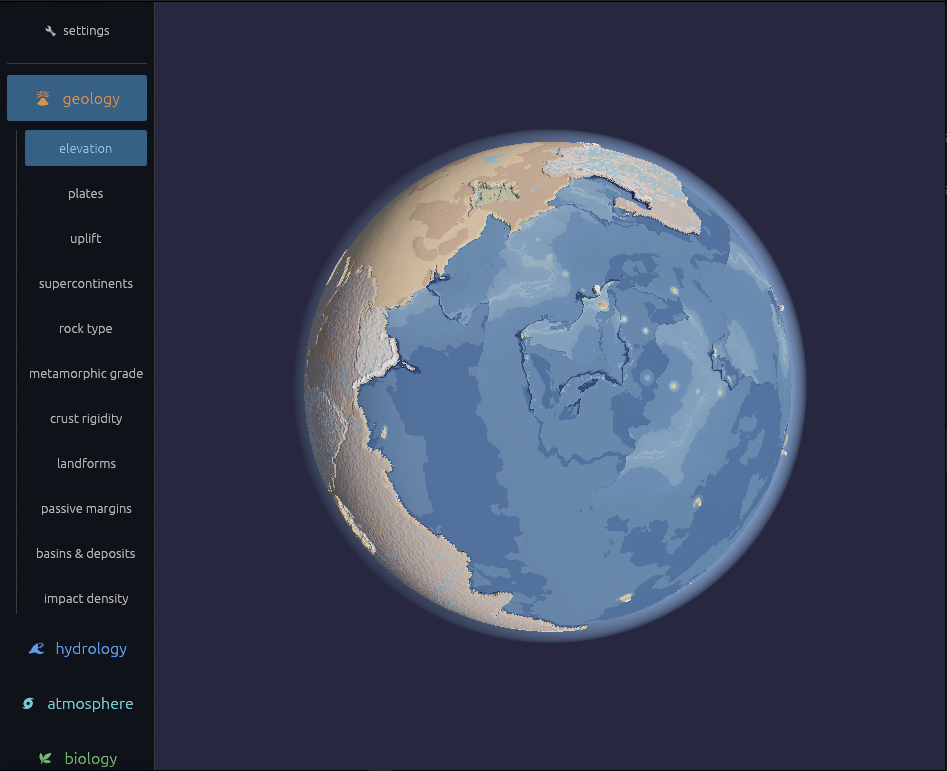
The whole planet is a pure function: F(x, t, seed). Position, time, seed — that's the entire state. No saved simulation, no RNG, no hidden database. That one decision buys three things that matter enormously if you care about AI:
It can't contradict itself. The same place at the same moment reads identically on every machine, forever. A world address fits in a short string — share it, and someone else stands on the exact same pebble.
It can explain itself. “Why is this desert here?” is not an inference — the cause is recorded. This plate boundary → this mountain range → this rain shadow → this desert. On Earth that chain takes an expert to reconstruct. Here it's a query.
It's honest about time. “Was this valley wet three months ago?” has one true answer, because t is just a parameter. You can run the clock backwards.
And because the world is made of facts rather than pixels, an AI can interview it directly. Our world daemon speaks the Model Context Protocol; an agent standing at any point can ask what's underfoot and get meaning, not screenshots:
footing: basalt bedrock | soil rock 0.8m | slope 0.16 aspect ENE
climate: ocean 28C rain3200 humid 1.00 light 0.54
far: sea on the horizon WSW / S / W @3.5-10km
Every answer traces to the world. The model narrating it is a translator and a query planner — never a fact source. The world cannot hallucinate; we don't let the narrator.
Where this goes
Here's the part we think matters beyond procedural planets.
A world like this is a strange kind of corpus: every statement in it has a decidable truth value and a recorded cause. The web — the corpus our models grow up on — has neither.
That makes a seeded world something like an epistemic gym. An agent that grows up anchored to one can practice being right: its predictions get graded against what actually happened, its beliefs carry validation against observation, provenance-checking becomes a reflex instead of a bolt-on. The facts of a synthetic world don't transfer to ours — a synthetic economy is not the economy. But the habits do, and so does the architecture: a hard boundary between an oracle that only reports what is, and an agent that owns its own beliefs and predictions.
And nothing in the contract says the world has to be made of rock. Coordinates, time, a causal generator, an honest oracle — that works for any domain with strong causal laws. Worlds made of firms and transactions. Worlds made of code. Deterministic, rewindable, checkable down to the last fact. We think that's what grounding actually looks like for the next generation of agents — and we're building towards it from the planet up.
Kano is in active development. If you're building agents that need somewhere real to stand — or you just want to watch a planet fall out of a number — we'd like to hear from you. There's more on what ships today on the Kano page.
— The Taniwha team
Building agents that need somewhere real to stand?
See what ships today, or tell us what you're building.